
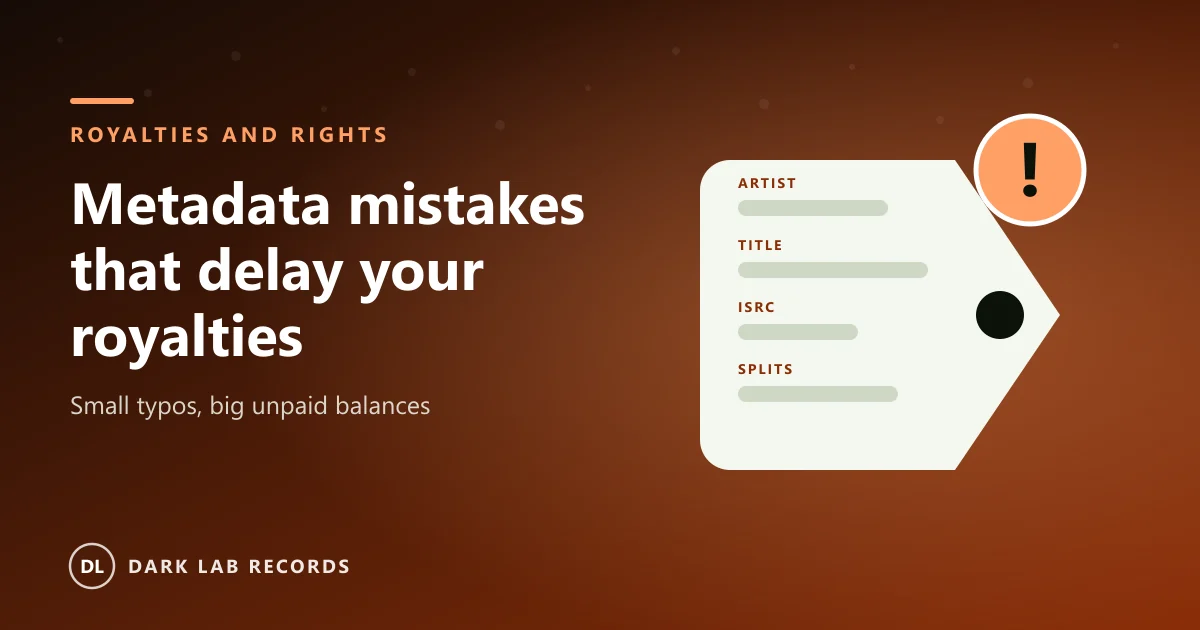
Metadata mistakes that delay your royalties
Behind every royalty payment is a match between a recording, a song and a person. That match is made by computers using the information you supply. If a name is spelled two ways or a code is missing, the match fails and the money waits.
On this page
Why metadata decides who gets paid
Stores report plays by recording. Collection societies and publishers match those plays to songs and writers. Each step depends on data being the same everywhere. A mismatch can mean a payment is held, sent to the wrong person or never claimed.
The mistakes that cost the most
- Spelling the artist name differently across releases, for example with and without a symbol or a featured artist in the title field.
- Reusing one ISRC for several recordings, or leaving the code off a release when it should have one.
- Leaving out songwriters and producers, or listing only the performing artist.
- Splits that do not add up to 100 percent, or that disagree with another registration.
- Using different titles for the same song on the store, the publishing registration and the society record.
- A wrong or outdated payment or contact detail with your distributor or society.
Fix it at the source
Decide on one exact version of your artist name and every song title, then copy it each time. Keep a simple sheet for each release with title, version, artists, writers, splits, ISRC, UPC, release date and label. Everything you register or deliver should match that sheet.
Tip: When you remix, re-edit or release an acoustic version, give it a new version tag and a new ISRC rather than reusing the original.
Check before you release
- Names and titles match your sheet exactly.
- Every writer and producer is listed with a split that agrees with the split sheet.
- Each track has its own ISRC and the release has a UPC.
- Your publishing and society registrations use the same titles.
- Your payment and contact details are current.
Correcting a release that is already live
If you find a mistake after release, tell your distributor straight away. Many errors can be fixed with a metadata update without taking the release down. Do not create a duplicate release to fix a typo, because that splits your plays and can cause the same recording to be paid twice or not at all.
Frequently asked questions
What is the difference between an ISRC and a UPC?
An ISRC identifies a single recording. A UPC identifies a whole release, such as a single or an album. You need both for most distribution.
Can I change metadata after release?
Usually yes, through your distributor. Some details are easier to change than others, so report mistakes as soon as you spot them.
How long can unmatched royalties wait?
It varies by society and territory. Unmatched money can sit for a long time, and in some cases it is shared out to other members, so it is worth fixing early.
Written by
Dark Lab Records Ltd team
Practical guidance on releasing music, video and publishing from the Dark Lab Records team in the UK, the United States and Canada.