
Remixes and samples: get permission before you release
A remix takes someone else's song and reshapes it. A sample takes a piece of someone else's recording and uses it in a new track. Both can make a record better. Both also use work that belongs to other people, so you need their permission before you release.
On this page
Two copyrights in one recording
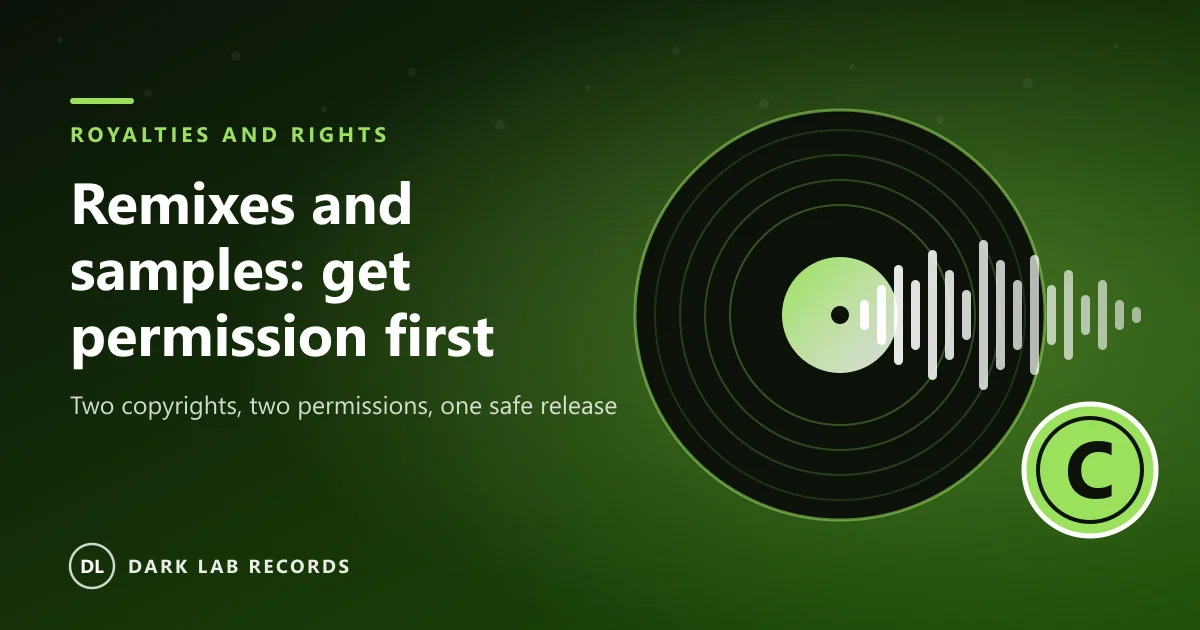
Almost every recording contains two separate rights. One is in the song itself: the melody, chords and lyrics, usually owned by the songwriters and their publishers. The other is in the recording: the actual performance captured on the file, usually owned by the artist or label that made it.
If you sample a recording you use both. You need permission from whoever controls the song and from whoever controls the recording. A remix of a full song is treated the same way.
Why short samples and free packs are not always safe
There is no number of seconds that makes a sample automatically legal. Even a short piece can need clearance if it is recognisable.
Sample packs and loop libraries are a safer starting point, but read the licence. Some allow commercial release, some do not, and some want a credit. Keep a copy of the licence and the receipt with the project.
How to ask for permission
- Identify the song, the writers, the publisher and the label that owns the recording.
- Contact the publisher and the label. Say what you want to use, how long it is, where it appears and how you plan to release it.
- Agree the terms in writing: a fee, a share of income, or both, plus credit and how long the licence lasts.
- Get the signed licence before you distribute, not after.
- Give your distributor a copy if they ask for it.
Official remixes and bootlegs
An official remix is commissioned or approved by the rights holder. You usually receive the stems, the terms are agreed up front and the release goes out with their blessing.
A bootleg is made without permission. Even when it is shared for free it can be taken down, and a release through a distributor will normally be rejected. Keep unlicensed remixes off the stores.
Tip: Ask for the stems from the rights holder. A remix built from official stems is a much easier conversation than one built from a ripped file.
What can go wrong
If you release without permission the rights holder can have the track removed, claim the income it earns or take legal action. A distributor may also close your account for repeated infringement. Clearing a sample before release costs much less than dealing with a dispute afterwards.
Frequently asked questions
Can I release a remix of a famous song if I do not sell it?
Not safely. Giving a track away does not remove the owner's rights. Without permission it can still be taken down.
Do royalty-free samples need clearance?
Usually not, but you must follow the licence that came with them. Check whether commercial release and distribution are allowed.
Who do I ask first, the label or the publisher?
Both are needed for a sample of a recording. Contact them at the same time so the terms line up.
Written by
Dark Lab Records Ltd team
Practical guidance on releasing music, video and publishing from the Dark Lab Records team in the UK, the United States and Canada.