
Split sheets explained: agree who owns what
When more than one person helps write a song, someone has to decide who owns what. If that conversation happens years later, after the song has earned money, memories differ and relationships suffer. A split sheet puts the agreement on paper on the day.
On this page
What a split sheet is
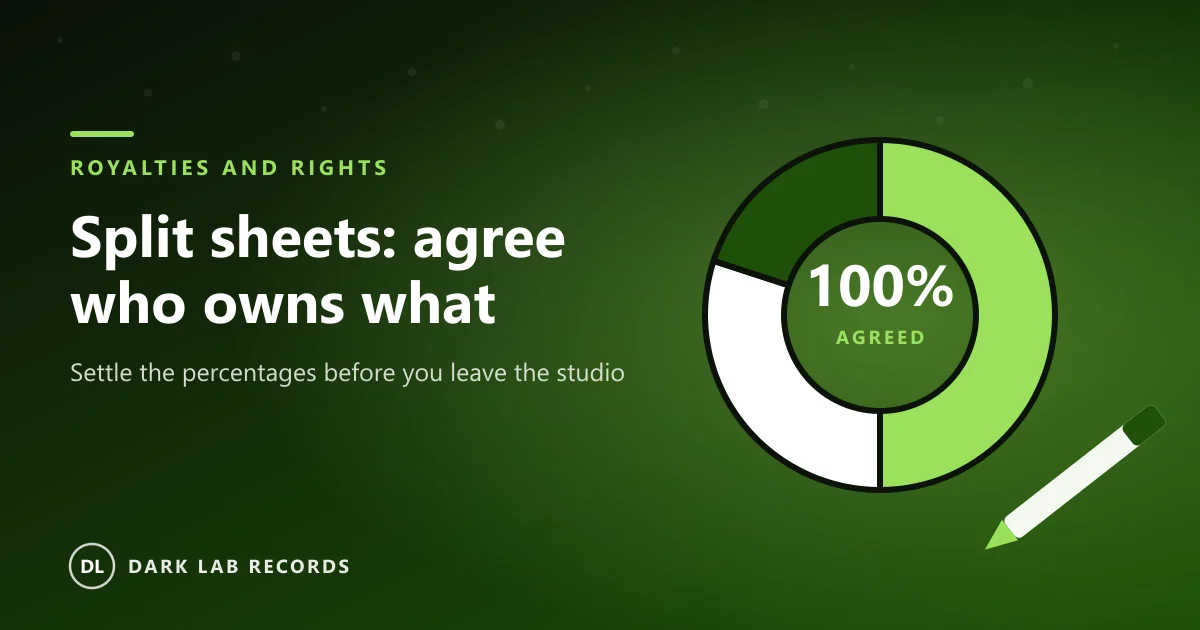
A split sheet is a short signed document that lists everyone who contributed to a song and the percentage of the songwriting each one owns. The shares add up to 100 percent.
It covers the song, meaning the melody, lyrics and composition. It does not by itself say who owns the recording. That is a separate agreement between the artists, producers and label.
What to put on it
- The song title and the date of the session.
- The full legal name of each writer and the name they perform under.
- Each writer's share as a percentage, adding up to 100.
- Each writer's publisher and collection society, if they have them, and their IPI number if known.
- Contact details for each person.
- A signature and date from every writer.
How splits are usually decided
There is no fixed rule. Many writers split equally among everyone in the room. Others weigh the contributions of lyric, melody and production separately. What matters is that everyone agrees and that it is written down.
Producers and beat makers can be treated differently. Some are paid a fee, some take a writing share, and some take a share of the recording instead. Agree it openly rather than assuming.
Tip: Fill in the sheet in the session, before anyone leaves. A photograph of a signed copy is better than a promise to send it later.
What it protects you from
A signed split sheet lets your publisher or society register the song correctly and pay the right people. It reduces the risk of a dispute holding up the royalties for everyone. It also gives your distributor the information they need to credit the writers correctly.
If the splits change later
Sometimes a lyric is rewritten or a new writer joins. Make a new split sheet that replaces the old one, have everyone sign it and tell any publisher or society that has already registered the song.
Frequently asked questions
Is a split sheet a legal contract?
It is a signed record of an agreement, and courts and societies treat it as strong evidence. For larger deals it is worth having a lawyer review a fuller agreement.
Do I need a split sheet if I wrote the song alone?
Not for splitting, but it is still worth keeping a record that shows you wrote it entirely.
Who keeps the split sheet?
Everyone who signed should keep a copy. Give one to your publisher, society or distributor when they need it.
Written by
Dark Lab Records Ltd team
Practical guidance on releasing music, video and publishing from the Dark Lab Records team in the UK, the United States and Canada.